FIBC Reuse & Refurbishment: A Practical Guide to Second-Life Bulk Bags
A FIBC that costs $10 to buy can carry product ten times if it is specified, inspected, and maintained correctly — or it can fail on the second lift and cost far more than $10 in spillage, downtime, and liability. The difference is not luck. It is a documented reuse and refurbishment program. For buyers running high-volume, repetitive bulk flows — minerals, resins, feed ingredients, construction materials — a second-life bag program is one of the fastest packaging cost reductions available, and it is also one of the most misunderstood.
This guide covers how single-use and reusable bags are actually rated, what a pre-reuse inspection must check, when cleaning is (and is not) enough, how refurbished bags are retested and marked, and when the right decision is to retire a bag and recycle it.
Single-Use vs. Reusable Ratings: 5:1 and 6:1
The distinction between single-use and reusable FIBCs is not marketing language — it is a design and testing difference, codified in ISO 21898 and reflected in the safety factor printed on the bag.
A single-use bag is built and tested to a 5:1 safety factor: its breaking strength is at least five times its Safe Working Load (SWL), and it is certified for one trip under normal conditions. A reusable bag is built and tested to a 6:1 safety factor, with additional testing that simulates repeated handling — extra drop and lifting cycles, and verification that seams and loops hold up after the bag has been filled, emptied, and refilled. The higher margin exists because a reused bag accumulates micro-damage with every cycle, and the 6:1 rating is the design’s way of absorbing that history.
Two practical consequences follow. First, never take a 5:1 single-use bag and simply reuse it because it “looks fine” — it was not designed for the second trip, and the manufacturer’s certification does not cover it. Second, if you are planning a reuse program, say so at the RFQ stage. A 6:1 reusable construction costs only slightly more (typically 5-15% above a single-use equivalent) but changes the loop, seam, and fabric spec in ways that matter over ten cycles. For the details on why safety factor is not interchangeable between programs, see our guide on how FIBCs are reused and why it matters.
Cost-Per-Cycle Economics: Where the Savings Come From
The economic case for reuse is straightforward, and it is why closed-loop packaging programs exist in every high-volume industry.
A standard 1000 kg FIBC costs $8-15 delivered. A single-use program spends that full amount on every trip. A reusable bag, at a similar purchase price, is designed for 5-10 cycles. Spread across five cycles — including roughly $1-2 per cycle for inspection and cleaning — the cost per use drops to about $3-4 by cycle five, a reduction of roughly 55% versus the single-trip benchmark, before even counting the avoided procurement overhead, storage, and disposal fees that a single-use program accumulates.
The numbers get better with volume because inspection and cleaning costs scale with throughput while the bag purchase is a one-time event. A site moving 100 bags per week with a five-cycle program needs roughly one-fifth the bag inventory of a single-use operation — which also means less warehouse space, fewer purchase orders, and less waste to dispose of. The tradeoff is discipline: the savings only materialize if every bag is inspected before every fill, because one failed bag in cycle three wipes out the economics of several good cycles.
The Pre-Reuse Visual Inspection Checklist
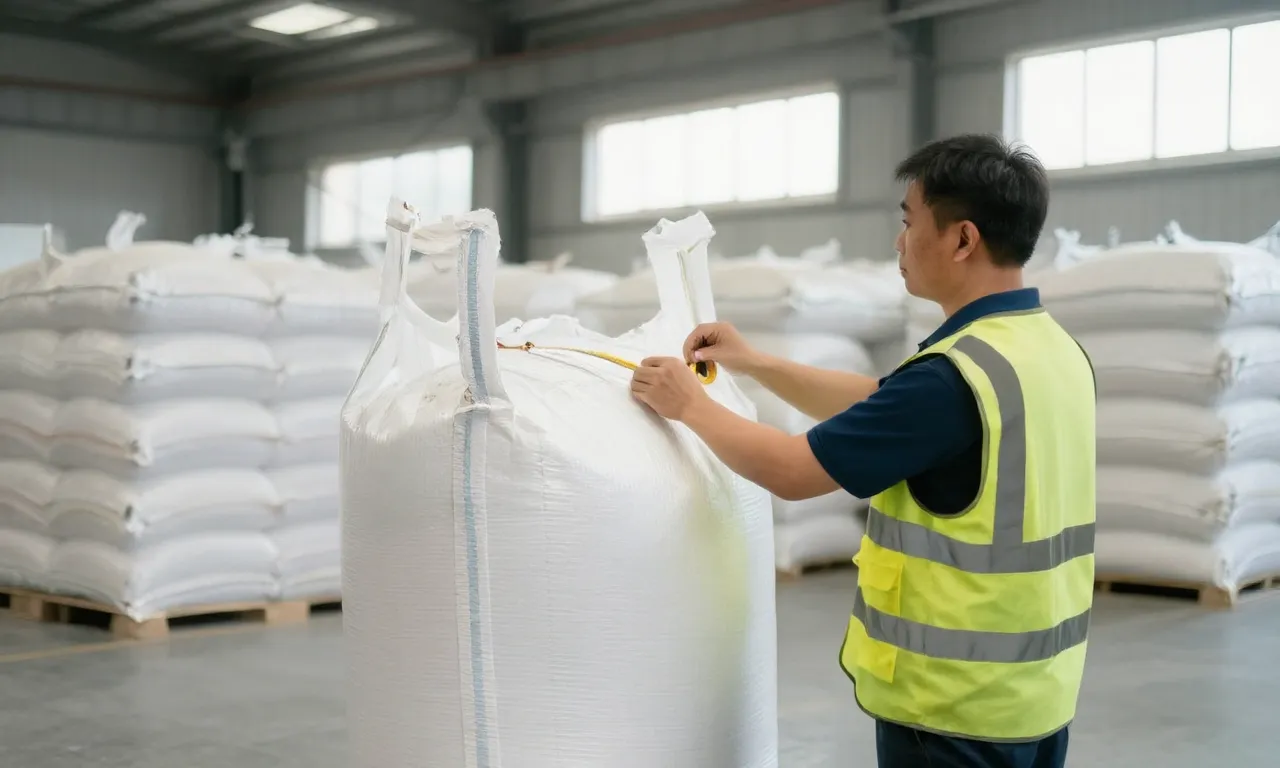
Every inspection before reuse follows the same five-point checklist. It takes under a minute per bag, and it is the single highest-value activity in the program.
- Fabric abrasion and cuts. Run your hand over the full bag surface. Look for scuffed areas, snags, and any cut or tear longer than 10-15 mm. On coated bags, pay attention to areas where the coating has worn away, since these lose both barrier and strength.
- Seam integrity. Check every vertical and bottom seam, plus the seam where lifting loops attach. Look for skipped stitches, pulled thread, or fabric pulling away from the seam line. A seam that is starting to separate will fail under load, not during inspection.
- Lifting loop condition. Loops are the most load-critical element of any FIBC. Check for fraying, cuts, and distortion at the loop ends where the strap is folded back and sewn. Reject any bag whose loops show wear that exposes the strap’s inner fibers.
- Coating damage. On PE-laminated or coated bags, inspect the coating for delamination, peeling, or pinholes. Damage on the inner face is more serious than the outer face, because it can contaminate product or compromise the moisture barrier.
- Stitching and closures. Verify the fill spout, discharge spout, and duffle-top stitching are intact and that all closures (ties, buckles, flaps) function correctly. A bag that cannot be closed properly is a spill and contamination risk regardless of fabric condition.
Any bag that fails an item is either repaired (if the damage is within a documented repair limit) or retired. Ambiguous bags go to a second inspection. In our experience running reuse programs for industrial clients, roughly 5-10% of bags are pulled from circulation at each cycle — and that number is a sign the program is working, not failing.
Cleaning Standards: Food-Grade vs. General Reuse
Cleaning requirements depend entirely on what the bag will carry next.
For general industrial reuse — moving the same or chemically compatible product — dry cleaning (vacuuming, brushing, compressed-air blowing) is usually sufficient, combined with a visual inspection for residue buildup. The bag’s previous contents must be compatible with the next load; a bag that held a reactive chemical should never carry a different chemical class without documented cleaning and risk review.
For food-grade reuse, the standard is dramatically higher. A bag that will contact food products must be washed with an approved food-safe detergent, rinsed thoroughly, and fully dried before storage or refilling. Residual moisture in a folded bag breeds mold and degrades the fabric, and residual detergent must not remain at levels that could transfer to product. Critically, chemical residue risk from the prior load must be assessed first: a food-grade wash cannot remove chemical contamination that has migrated into the fabric, so a bag that previously held industrial chemicals cannot simply be “washed to food-grade.” For food-contact applications, many buyers sensibly restrict reuse to bags that have only ever carried food-grade loads — see our food-grade FIBC guidance for what virgin-material and documented-cleanliness requirements actually mean.
Reuse programs that require cleaning should track wash cycles in the bag’s history. After a defined number of washes — typically 10-20 depending on detergent aggressiveness — the fabric and stitching degrade enough that the bag should be retired even if it visually passes.
Re-Testing and Marking Refurbished Bags
A reused bag is only as good as the evidence that it is still within its design limits. For reusable (6:1) bags, the manufacturer’s test program typically includes loop load testing — lifting the filled bag and holding it to verify loops and seams take the load — and drop testing on a sample basis to verify the fabric still absorbs impact without tearing. At minimum, the loop load test should be performed on every bag whose loop condition was questionable, and a representative sample (5-10% of the batch) should be drop-tested after cleaning.
Refurbished bags must be marked so the program can be audited. Standard practice is a durable tag or ink marking showing: the reuse count or cycle number, the date and result of the last inspection, the cleaning date and method, and the inspector’s identifier. This marking chain is what makes a reuse program defensible in an audit or a liability claim — without it, you cannot prove a bag was fit for the load it carried.
Common Failure Modes: UV Degradation and Crease Cracking
Two failure modes dominate reused-bag populations, and both are preventable with correct storage.
UV degradation is the number one killer of FIBC fabric. Polypropylene loses tensile strength steadily under sunlight — unprotected fabric can lose 30-50% of its strength over a season of outdoor storage. Bags stored outdoors or on open trailers degrade invisibly from the outside in. The mitigation is storage discipline (covered, shaded, off the ground) and UV-stabilized fabric (1-3% stabilizer loading) specified at purchase for any bag that will live outdoors between cycles.
Crease cracking occurs where folded fabric is repeatedly flexed under load — typically at the bottom corners and along fold lines of bags stored flat. The tape yarns fatigue and fracture, producing hairline cracks that may not show until the bag is under full load. This is why bags should be stored with minimal folding and stacked consistently, and why the inspection must flex-fold suspect corners rather than just looking at them.
When to Retire a Bag
Retirement criteria should be written down before the program starts, not decided at the moment a damaged bag appears. Retire a bag when any of the following applies:
- Any cut, tear, or abrasion that exposes or damages the load-bearing fabric structure.
- Seam or loop damage that cannot be repaired within the manufacturer’s documented repair limits (most manufacturers allow certain loop and seam repairs; none allow fabric-panel replacement).
- Fabric stiffness, discoloration, or chalking that indicates UV degradation.
- Reaching the manufacturer’s rated cycle count or maximum age (commonly 24-36 months from first use, depending on exposure).
- Any history of carrying a product that makes future loads unsafe — chemicals, contaminated materials, or unknown residues.
A retired bag is not necessarily waste. End-of-life recycling is well established: clean polypropylene FIBCs are shredded, washed, and extruded into PP pellets or flakes that re-enter the plastics stream for non-critical applications (strapping, crates, agricultural film). Recycled-content bags are never suitable for food contact, but they close the loop for industrial applications and are an increasingly common sustainability requirement in sustainable FIBC programs.
Building a Closed-Loop Program
The economics above assume a closed loop: bags return from the customer or from the receiving site, get inspected and cleaned, and re-enter the filling line. The return logistics often determine whether reuse is worth it at all, so plan them before committing to the bag spec.
The two standard models are depot-based pooling (a third party owns and manages the bag pool, handling collection, inspection, cleaning, and certification at scale) and internal return loops (the buyer’s own sites return bags on backhauls or consolidated shipments). Internal loops work when distances are short and volumes are steady; pooling makes sense when the bag must travel far, because empty-bag freight can quickly erase the per-cycle savings. As a rough planning number, reuse programs stay attractive while return freight and handling stay below roughly 30-40% of the single-use bag cost — beyond that, the economics flip.
The loop also needs an inventory model: bags in circulation (out with customers), bags in inspection/cleaning, and bags available for fill. A five-cycle program needs roughly one-fifth the bag count of a single-use program at the same fill rate, but it needs the discipline of a queue — if inspection backs up, the filling line starves. Many programs fail not because the bags fail, but because nobody owned the return flow. Assign ownership of the loop at the start; it is a process, not a pile of bags.
Common Mistakes in Reuse Programs
After working with reuse programs across minerals, feed, and construction industries, we see the same errors repeat:
- Reusing single-use bags “just this once.” The 5:1 bag was not tested or certified for cycle two. One informal reuse may work; the hundredth will not, and the liability is yours because the certification no longer covers the use.
- Skipping the inspection on “clean-looking” bags. Damage is load-bearing before it is visible. A bag can fail the loop test while looking perfect.
- Cleaning without a standard. “Washed” is not a specification. Approved detergent, rinse, full dry, and a documented wash-cycle count are the minimum for any food-adjacent reuse.
- Ignoring storage conditions. Bags left in the sun for a season lose strength invisibly. UV is the silent accumulator of failure risk.
- No marking, no history. Without cycle counts and inspection dates on the bag, you cannot prove fitness for use — and you cannot retire bags on schedule either.
None of these failures is expensive to prevent. All of them are expensive when they occur, because a failed bag in reuse fails with more history behind it than a failed new bag — and the question “why did you reuse a bag that was not rated for reuse?” is not one you want to answer in a claim investigation.
The Practical Takeaway
Reuse is a procurement decision before it is an operations decision. Specify 6:1 reusable construction at the RFQ, budget for inspection and cleaning as a real per-cycle cost, write the retirement criteria before the first cycle, and mark every bag so the program is auditable. Done properly, a 5-10 cycle reuse program cuts packaging cost per use by more than half while reducing procurement, storage, and disposal overhead — and keeps 80-90% of the polypropylene in service instead of in a landfill. The inspection discipline is the entire game: it costs a minute per bag, and it is what separates a cost-saving program from a liability.