FIBC Quality Control & Testing Guide: ISO 21898 Standards Explained
Every FIBC that leaves a factory carries a rated safe working load — typically 500 to 2000 kilograms. But how was that rating determined? Was the bag actually tested to that load, or is the number based on fabric weight calculations alone? For procurement managers sourcing FIBCs from overseas manufacturers, understanding the quality control and testing landscape is not optional — it is the difference between bags that perform reliably under load and bags that fail catastrophically in the field, potentially causing product loss, equipment damage, and serious injury.
This guide explains ISO 21898:2024, the international standard governing FIBC testing, breaks down each core test procedure and its pass criteria, explains safety factors in practical terms, and provides a QC checklist you can use when auditing suppliers.
Understanding ISO 21898:2024
ISO 21898 is the international standard that specifies testing and certification requirements for flexible intermediate bulk containers. The 2024 revision introduced several important updates, including more rigorous cyclic top lift testing procedures, clarified stacking test duration requirements, and expanded guidance on UV aging validation.
The standard covers both single-trip (single-use) and multi-trip (reusable) FIBC classifications. Single-trip bags are tested to a 5:1 safety factor — meaning the bag must withstand five times its rated safe working load without failure. Multi-trip bags require a 6:1 safety factor, reflecting the cumulative stress of repeated filling, handling, transport, and discharge cycles. This distinction is critical: a bag certified for single use at 1000 kg SWL has been tested to 5000 kg, while a reusable bag at the same SWL must pass 6000 kg testing.
Core FIBC Testing Procedures
Top Lift Test (Cyclic)
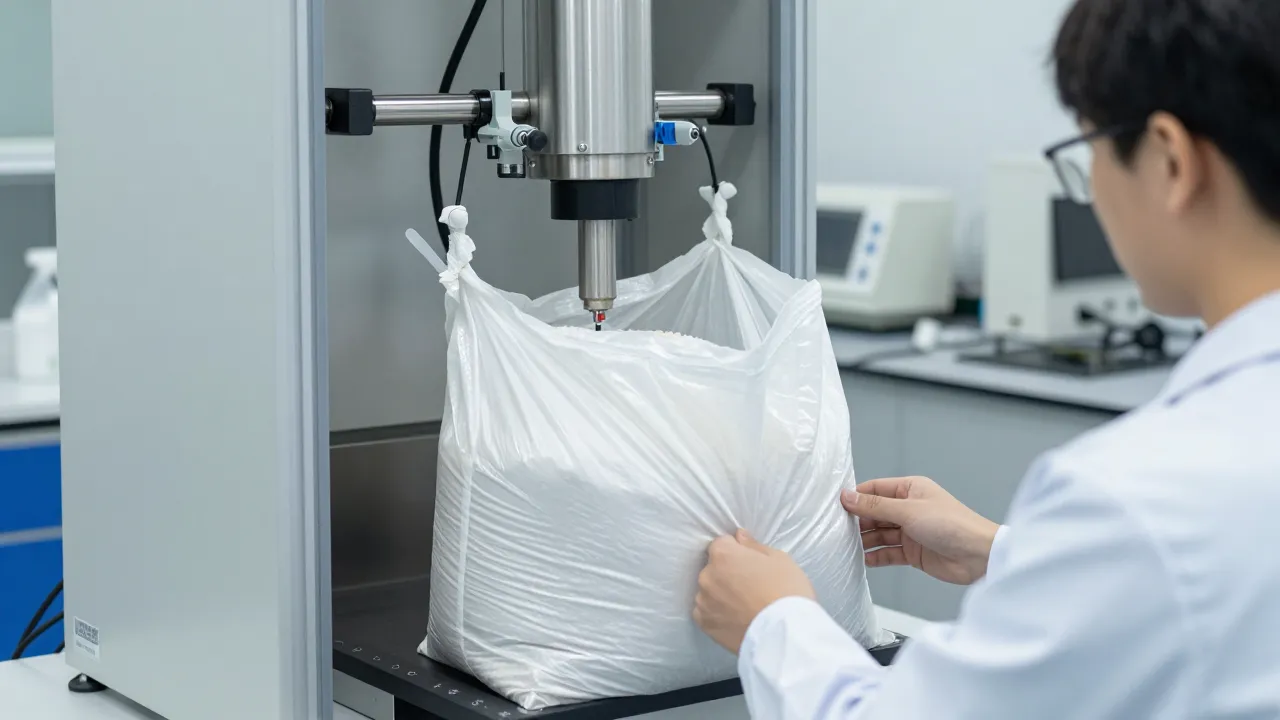
The top lift test is the single most important FIBC qualification test. The bag is filled to its rated SWL, lifted by its specified lifting loops, and held suspended for the prescribed duration. Under ISO 21898:2024, the cyclic variant requires the bag to be lifted and lowered repeatedly — typically 30 cycles — to simulate real-world handling conditions. The bag must show no evidence of seam separation, loop detachment, fabric tearing, or permanent deformation that would compromise subsequent use.
Manufacturers perform this test on every new FIBC design and periodically on production samples. A bag that passes top lift testing demonstrates that the lifting loop attachment design, seam construction, and fabric strength work together as an engineered system.
Stacking Test
The stacking test verifies that filled FIBCs can be stacked without buckling or collapse. A filled bag is loaded with a compressive force equivalent to the weight of bags stacked above it — typically three to five bags high — for a minimum of 24 hours. The bag must maintain its structural integrity, with no significant deformation, leaning, or fabric creep that could lead to stack instability in warehouse storage.
This test is particularly important for 4-panel FIBCs and U-panel FIBCs, where shape stability under load directly affects warehouse safety and space utilization.
Drop Test
The drop test evaluates what happens when a filled FIBC is accidentally dropped — a scenario that occurs with unfortunate regularity in real-world handling. The bag is filled to its SWL and dropped from a height of 0.8 to 1.2 meters onto a hard surface, in orientations representing the most likely impact scenarios. The bag must not rupture, and any product loss must be within acceptable limits. This test validates seam strength under shock loading, which is fundamentally different from the steady-state loading verified by the top lift test.
UV Aging Test
For bags intended for outdoor storage or exposure, UV resistance testing is essential. Fabric samples are exposed to accelerated UV aging in a xenon arc or fluorescent UV chamber, then tested for residual strength. The standard requires that after UV exposure equivalent to the claimed outdoor service life — typically 3 to 12 months — the fabric retains at least 50% of its original tensile strength. UV stabilization at 1-3% is standard, but the actual performance must be verified through testing, not simply assumed from additive percentages.
Safety Factor Explained: 5:1 vs 6:1 vs 8:1
The safety factor is the ratio between the minimum breaking strength and the rated safe working load. A 5:1 SF means a bag rated at 1000 kg SWL has a minimum breaking strength of 5000 kg. This margin exists not because the bag is expected to see 5000 kg loads, but because real-world handling introduces dynamic forces (sudden stops, swinging, uneven loading) that create peak stresses far above the static weight of the contents. The safety factor absorbs these unpredictable dynamic loads.
Standard single-use bags use 5:1. Reusable bags require 6:1. For critical applications involving hazardous materials or high-value products, some specifiers require 8:1 safety factors. Each increase adds material cost and weight, so the safety factor should be matched to the actual risk profile of the application rather than maximized by default.
Third-Party Certification: What to Look For
The most reliable FIBC testing is performed by independent, ISO/IEC 17025 accredited laboratories. When a manufacturer provides a test certificate, verify the following:
First, confirm the testing laboratory is accredited by a recognized national accreditation body (such as A2LA in the United States, UKAS in the United Kingdom, or CNAS in China). Second, verify that the test certificate references the specific bag design, fabric specification, and production batch — not just a generic “type” certificate. Third, check the test date: certificates older than one year may not reflect current production quality. Fourth, look for photographic documentation of the test setup, which provides visual confirmation that testing was actually performed.
A reputable manufacturer welcomes third-party testing requests and can arrange testing through international laboratories when required by the buyer’s quality assurance program.
QC Checklist for Supplier Audits
When visiting or auditing an FIBC manufacturer, use this checklist to evaluate their quality control capability:
- Are top lift test fixtures and calibrated load cells available on-site?
- Does the manufacturer perform cyclic testing or only single-lift tests?
- Are drop test facilities (hard surface, lifting mechanism) maintained and used regularly?
- Is UV aging test equipment (xenon arc or QUV chamber) available for fabric qualification?
- Are test records maintained with traceability to production batches?
- Does the manufacturer hold third-party certifications (ISO 9001, ISO 22000 for food-grade)?
- Are production samples tested at statistically meaningful frequencies (not just one bag per design)?
Red Flags: Common Testing Shortcuts
Several shortcuts indicate inadequate QC commitment. Be alert for: test certificates that show only fabric tensile strength but no completed bag testing (fabric strength alone does not equal bag strength); cyclic tests performed at reduced load; drop tests conducted from lower heights than the standard; UV aging claims based on additive percentage rather than exposure testing; and test certificates from laboratories that cannot be verified through the accreditation body’s public database. Any of these shortcuts should prompt deeper investigation before placing an order.