FIBC Bags in Construction: Bulk Material Handling
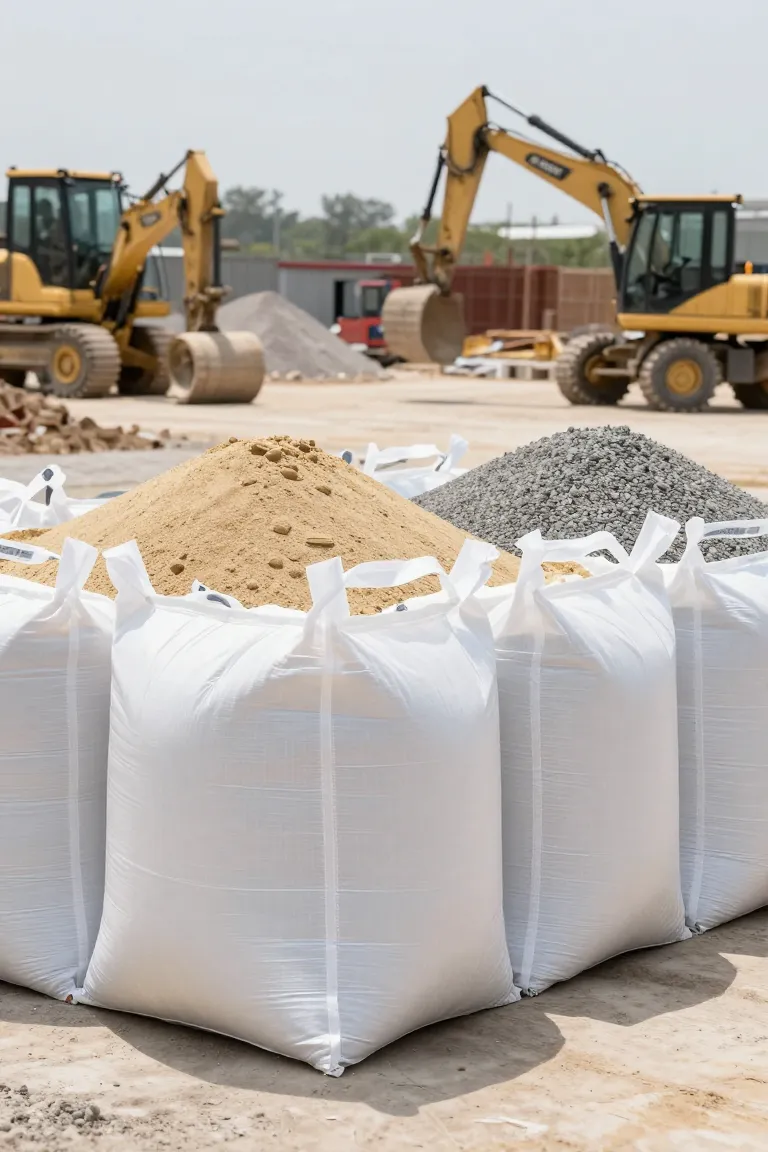
Construction sites run on materials. Sand, gravel, cement, crushed stone, and dry mortar arrive in bulk and must be moved, stored, and dispensed efficiently to keep projects on schedule. For decades, the construction industry relied on small bags, loose dumps, and rigid containers — methods that are labor-intensive, wasteful, and difficult to scale. FIBC construction packaging has changed that equation entirely. Flexible Intermediate Bulk Containers, commonly known as bulk bags or jumbo bags, offer a practical, cost-effective solution for transporting and storing heavy construction materials in quantities ranging from 500 to 2,000 kilograms per bag.
Whether you manage a ready-mix concrete plant, a building supply yard, or a large infrastructure project, understanding how FIBC bags fit into construction logistics can reduce handling costs, minimize material loss, and improve site safety.
What Role Do FIBC Bags Play in Construction
FIBC bags serve as the primary intermediate packaging for a wide range of dry, flowable construction materials. Their role extends beyond simple containment — they function as a logistics unit that integrates filling, transport, storage, and discharge into a single packaging system.
On a typical construction project, bulk bags handle materials such as sand, gravel, crushed aggregate, cement, lime, fly ash, gypsum, dry mortar mix, and insulation granules. Each of these materials has distinct physical properties — particle size, moisture sensitivity, flow characteristics, and bulk density — that influence which FIBC design is most appropriate.
The construction sector values FIBC bags for their ability to replace dozens of smaller sacks with a single unit. One standard bulk bag carrying 1,000 kg of sand replaces forty individual 25 kg sacks. That consolidation reduces packaging waste, cuts loading and unloading time, and lowers the per-ton cost of material handling. For projects in remote locations or areas with limited infrastructure, FIBC bags can be transported on flatbed trucks and lifted by crane or forklift directly to the point of use, eliminating the need for silos or specialized unloading equipment.
Compared with FIBC vs rigid containers, flexible bulk bags offer significant advantages in storage efficiency. Empty bags fold flat, occupying a fraction of the space required by drums or rigid IBCs. This matters on crowded construction sites where space for staging empty packaging is limited.
Why FIBC Bags Are Ideal for Construction Sites
High Load Capacity with Proven Safety
Construction materials are heavy. A cubic meter of dry sand weighs approximately 1,600 kg, and gravel can exceed 1,800 kg per cubic meter. FIBC bags are engineered to handle these loads with safety factors built into every design. Standard single-trip bags carry a Safe Working Load (SWL) of 500 to 2,000 kg with a 5:1 safety factor, meaning the bag’s minimum breaking strength is five times its rated capacity. Multi-trip bags use a 6:1 safety factor for additional margin. This engineering rigor ensures that bags perform reliably under the demanding conditions of construction sites, where rough handling, outdoor exposure, and mechanical lifting are routine.
Weather Resistance for Outdoor Storage
Construction materials are frequently stored outdoors, exposed to sunlight, rain, and temperature fluctuations. Woven polypropylene — the base material for FIBC bags — resists moisture absorption, microbial growth, and chemical degradation. UV-stabilized bags incorporate additives that protect the fabric from ultraviolet degradation during extended outdoor exposure. For moisture-sensitive materials like cement and dry mortar, FIBC bags can be fitted with internal polyethylene liners that create a barrier against humidity and condensation, preserving material quality during storage periods that may extend for weeks or months.
Efficient Handling with Standard Equipment
Every construction site has forklifts and cranes. FIBC bags are designed with lifting loops that integrate directly with standard handling equipment. Cross-corner loops work with forklift tines, while stevedore loops accommodate crane hooks for vertical lifting. This compatibility means no specialized equipment is needed — a critical advantage on job sites where equipment variety is limited. Filled bags can be stacked two or three high to maximize storage density, and discharge spouts allow controlled emptying without cutting the bag or creating dust clouds.
Cost-Effective Packaging at Scale
The economics of FIBC construction packaging are compelling. Per-ton packaging costs for bulk bags are significantly lower than small sacks, rigid containers, or silo systems. The reduction in labor for filling, handling, and disposal adds further savings. For high-volume material flows — such as a concrete batch plant consuming hundreds of tons of aggregate per week — the cumulative cost advantage of FIBC bags over alternative packaging can represent substantial savings over the life of a project.
Common Construction Applications
In FIBC construction applications, the versatility of these bags makes them suitable for nearly every dry material handling need on a job site. Understanding the most common applications helps specifiers choose the right bag design for each material type.
Sand and Aggregate Transport. Sand, gravel, and crushed stone are among the most frequently packed materials in FIBC bags within the construction sector. These granular materials flow easily and exert moderate pressure on bag walls. Standard U-panel or circular woven bags with open tops and flat bottoms handle these materials effectively. For heavier aggregates, consider types of FIBC bags with reinforced loops and heavier fabric weights rated for loads above 1,500 kg.
Cement and Dry Mortar. Cement and dry mortar mixes are moisture-sensitive and fine-powdered, requiring bags with sift-proof seams and internal liners. FIBC bags for cement typically feature a filling spout at the top for controlled filling at the plant and a discharge spout at the bottom for clean, metered emptying at the job site. The liner protects against humidity during transport and storage, preventing clumping and maintaining the free-flowing properties of the material. Baffle bags — which maintain a square shape when filled — are popular for cement because they stack efficiently and maximize pallet and container utilization.
Fly Ash and Mineral Additives. Fly ash, silica fume, and other mineral additives used in concrete production are extremely fine powders that tend to sift through standard weave fabrics. These materials require coated or laminated FIBC bags with sift-proof construction. The coating acts as a barrier, preventing fine particles from escaping while maintaining the bag’s structural integrity. Static-dissipative or conductive bags may also be required if the filling environment involves combustible dust concentrations.
Lime and Gypsum. Quicklime, hydrated lime, and gypsum are alkaline materials that require careful handling to protect workers and preserve material quality. FIBC bags for lime often incorporate multiple layers of protection: an outer woven PP shell for strength, an inner liner for moisture protection, and coated fabric to contain fine dust. Some specifications call for UN-certified bags when transporting certain lime products classified as hazardous under transport regulations.
Insulation and Lightweight Fill. Expanded clay, perlite, vermiculite, and other lightweight fill materials present a different challenge — their low bulk density means large volumes with relatively low weight. For these applications, larger-capacity FIBC bags with wide filling openings and low fabric weights are most cost-effective. The bag must retain the lightweight particles while allowing efficient air displacement during filling to prevent ballooning.
Soil Stabilization and Erosion Control. FIBC bags filled with sand or soil serve as structural elements in erosion control, flood defense, and temporary retaining walls. In these applications, the bags are not emptied — they remain in place as part of the construction. Standard construction-grade bags with UV stabilization are specified for these permanent or semi-permanent installations, where the bags must maintain integrity under prolonged sun exposure and ground contact.
How to Select FIBC Bags for Construction
Choosing the right FIBC bag for construction applications requires matching bag specifications to the material, the handling environment, and the logistics chain. Start with these key decision points.
Determine the Safe Working Load. Calculate the maximum weight of material per bag based on material bulk density and desired fill volume. Select a bag with an SWL rating that exceeds your maximum fill weight. For construction use, 1,000 kg and 1,500 kg SWL ratings are the most common. Always verify that the safety factor (5:1 for single-trip, 6:1 for multi-trip) is certified by the manufacturer.
Choose the Right Construction Type. U-panel bags offer excellent stability for stacking and are well suited to granular materials like sand and gravel. Circular woven bags provide uniform strength distribution and are economical for standard applications. Baffle bags maintain a square profile when filled, maximizing stacking density — ideal for cement, mortar, and warehouse storage. Four-panel bags handle very heavy loads with superior dimensional stability.
Specify Filling and Discharge Options. Match the top and bottom configurations to your filling and emptying processes. Open-top bags are simplest for bulk materials loaded by shovel or conveyor. Spout-top bags enable controlled, dust-free filling through a chute. For discharge, flat-bottom bags are emptied by cutting, while spout-bottom bags allow controlled, reclosable emptying. Construction sites handling cement or mortar benefit from spout-top, spout-bottom configurations for clean, efficient operations at both ends of the logistics chain.
Consider Environmental Conditions. If bags will be stored outdoors for extended periods, specify UV-stabilized fabric rated for the expected exposure duration — typically 1,600 hours of UV protection is standard for construction applications. For moisture-sensitive materials, include internal PE liners of appropriate thickness. For fine powders that generate dust, coated fabric with sift-proof seams prevents material loss and protects worker health.
Evaluate Reusable vs. Single-Trip Options. Construction projects with closed-loop logistics — where empty bags can be returned to the filling point — may benefit from multi-trip FIBC bags. However, most construction applications use single-trip bags due to the difficulty of collecting and returning bags from distributed job sites. Work with our product range to compare the total cost of ownership between single-trip and multi-trip options for your specific logistics model.
Frequently Asked Questions
What size FIBC bag is best for construction sand?
The most common size for construction sand is a bag with dimensions of approximately 90 x 90 x 110 cm, which holds roughly one metric ton of dry sand. However, the ideal size depends on your handling equipment capacity and the bulk density of your specific sand type. Coarse builder’s sand is less dense than fine silica sand, so the same bag volume will carry a different weight. Always specify the bag based on the actual material density at your site rather than generic estimates.
Can FIBC bags be stored outdoors on construction sites?
Yes, FIBC bags can be stored outdoors when manufactured with UV-stabilized polypropylene fabric. Standard UV protection ratings range from 400 to 1,600 hours of direct sunlight exposure, which corresponds to several months of outdoor storage in most climates. For moisture-sensitive materials like cement, internal polyethylene liners provide an additional barrier against rain and ground moisture. Elevate stored bags on pallets to prevent contact with standing water, and cover stacks with tarps during extended storage for maximum protection.
Are FIBC bags safe for lifting by crane on job sites?
FIBC bags are designed for crane lifting when equipped with appropriate lifting loop configurations. Stevedore loops — single loops that extend from each corner — are the standard choice for crane operations. The bag must be certified for the stated Safe Working Load with the appropriate safety factor, and the lifting attachment must engage all four loops simultaneously to distribute the load evenly. Never lift a bag by fewer than all four loops, and inspect loops for damage or wear before each lift. Following the manufacturer’s lifting instructions is essential for safe crane operations.
How do FIBC bags compare to small sacks for cement on site?
One standard FIBC bag carrying 1,000 kg of cement replaces forty 25 kg sacks. This consolidation reduces packaging material waste by approximately 85 percent, cuts the number of lifting operations by a factor of forty, and lowers the risk of back injuries among workers. FIBC bags with spout bottoms also enable cleaner, faster discharge compared to cutting and pouring small sacks. The per-ton cost of FIBC packaging is lower than small sacks when accounting for labor, handling time, and disposal costs.
What certifications should construction FIBC bags have?
At minimum, construction FIBC bags should carry a manufacturer’s certificate confirming the Safe Working Load, safety factor, and fabric specification. For applications involving hazardous materials — such as certain types of lime or treated aggregates — UN certification under the IMDG Code or ADR regulations may be required. ISO 21898 certification demonstrates compliance with the international standard for FIBC design and testing. If bags will be used in food-adjacent applications such as agricultural lime for soil amendment, food-grade certifications like BRC or FDA compliance may also be relevant.
Get the Right FIBC Solution for Your Construction Project
Every construction project has unique material handling requirements — from the types of materials being moved to the site conditions and logistics constraints. Selecting the right FIBC bags for your application ensures safe, efficient, and cost-effective bulk material handling from the supplier to the point of use.
At FIBC Sourcing Partner, we supply a full range of construction-grade bulk bags, from standard U-panel and circular bags for sand and aggregate to specialized coated and lined bags for cement, lime, and fine mineral powders. All of our construction FIBC bags are manufactured to certified safety standards with full traceability documentation. Explore our product range to find the specifications that match your project requirements, or contact our team for a tailored recommendation based on your material types and logistics setup.